
Spectral Precision for Plant Research
Phytotrons, in-vitro culture, high-throughput phenotyping and photomorphogenesis: spectra controlled to ±5 nm, reproducible data, spectral drift <5% over the full lifetime.
Spectral precision
µmol/m²/s max PPFD
Spatial uniformity
Drift over 50,000 h
Plant Research Requirements
Plant biology research imposes lighting constraints far more stringent than production environments. Every parameter must be quantifiable, reproducible and traceable.
Spectral Precision ±5 nm
Isolates the effect of narrow spectral bands on photomorphogenesis. Each LED channel is individually characterised by spectroradiometry to guarantee the fidelity of targeted wavelengths.
Phytotron & Growth Chambers
Fully controlled environment: temperature (-2 to +40°C), relative humidity, CO² and light. PPFD adjustable from 600 to 1,200 µmol/m²/s to simulate any canopy type.
Spatial Uniformity 90-95%
Maximum variation of ±5 to 10% PPFD across the entire cultivation surface. Mapping validated by a network of calibrated quantum sensors and DIALux simulation.
Horticultural Metrics, Not CRI
CRI is irrelevant for plants. Our fixtures are characterised by full spectrum, PPF/PPFD (µmol/s), efficacy (µmol/J), DLI (mol/m²/day) and R/B, R/FR ratios.
DIN 5031-10 Standards
Photomorphogenic action curves in compliance with DIN 5031-10. Reference spectra for germination, elongation, flowering and pigment synthesis.
Full Reproducibility
Spectral drift <5% over 50,000 hours. Each fixture is delivered with an individual spectral calibration certificate, ensuring inter-laboratory reproducibility.
Photoreceptors & Photomorphogenesis
Each spectral band activates specific photoreceptors that drive plant development. Understanding these mechanisms is essential to designing the optimal spectrum.
UVR8
UV-B: 280-315 nm
Photoprotection, flavonoid and anthocyanin synthesis. Defences against radiative stress.
CRY / PHOT
Blue/UV-A: 320-500 nm
Cryptochromes and phototropins. Inhibition of elongation, stomatal opening, phototropism.
Phytochrome Pr
Red: 660 nm
Inactive form Pr absorbs red light. Switches to active form Pfr. Controls germination and flowering.
Phytochrome Pfr
Far-Red: 730 nm
Active form Pfr absorbs far-red. Regulates stem elongation, shade avoidance and floral transition.
Pr ↔ Pfr Switch: The Central Regulator
The Pfr/Ptotal ratio (known as PSS — Phytochrome Stationary State) determines the photomorphogenic response. A high PSS (red-660 nm-rich) promotes compactness, while a low PSS (far-red-730 nm-enriched) stimulates elongation and shade avoidance.
Compact plant, thick leaves
Elongation, shade avoidance
Cross-Talk Between Receptors
Photoreceptors do not operate in isolation. A complex signalling network integrates the information from each receptor to coordinate plant development.
-
CRY + PHY: blue light modulates phytochrome sensitivity via COP1/SPA genes.
-
UVR8 + CRY: UV-B amplifies photoprotective responses already initiated by blue light.
-
PHY + gene networks: PIFs (Phytochrome Interacting Factors) regulate hundreds of downstream genes.
-
Hormonal integration: auxins, gibberellins and brassinosteroids synergise with light signalling.
Research Applications
Our LED systems equip the most demanding laboratories in Europe across diverse fields of plant biology.
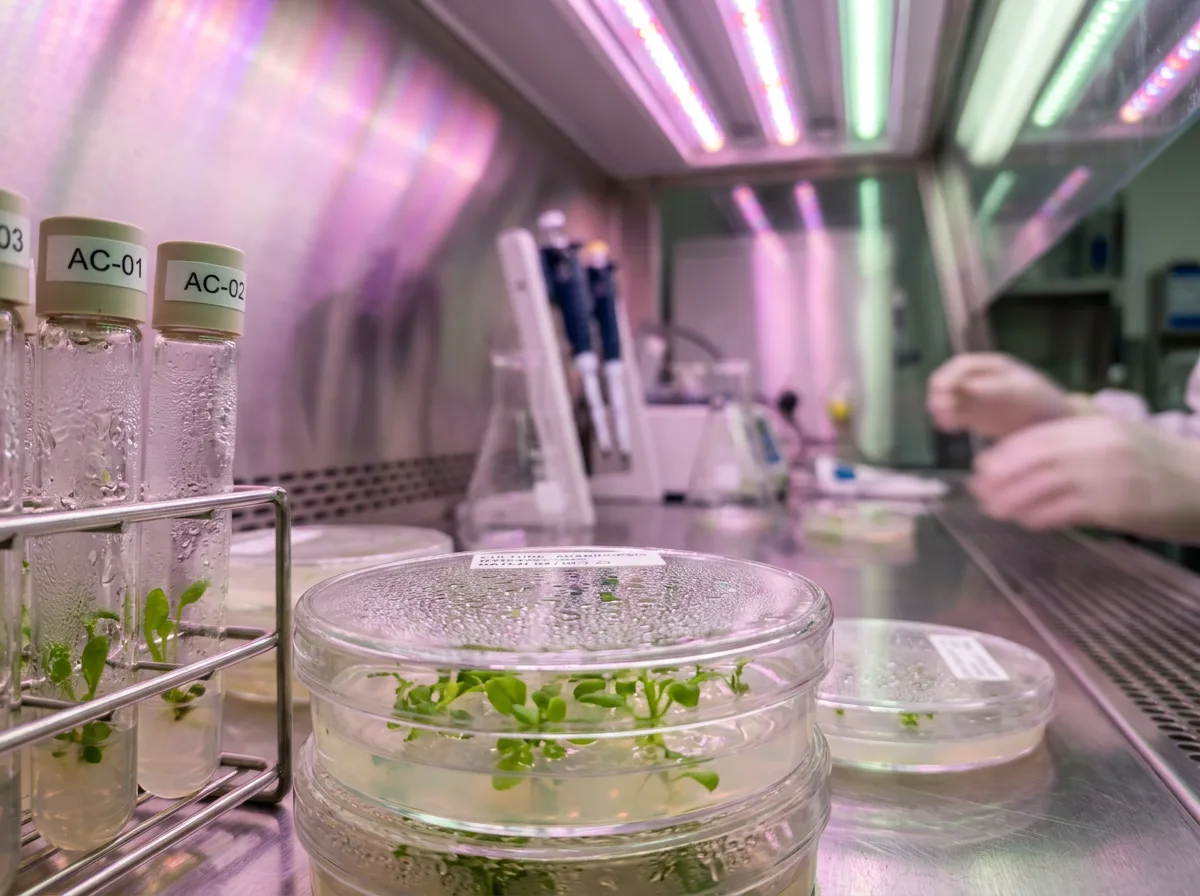
In-Vitro Culture
LED vs. fluorescent: less radiant heat (no infrared), improved long-term spectral stability, enhanced explant compactness. Ideal for micropropagation and organogenesis.
- PPFD 50-150 µmol/m²/s
- Adjustable R/B ratio
- Zero radiant heat
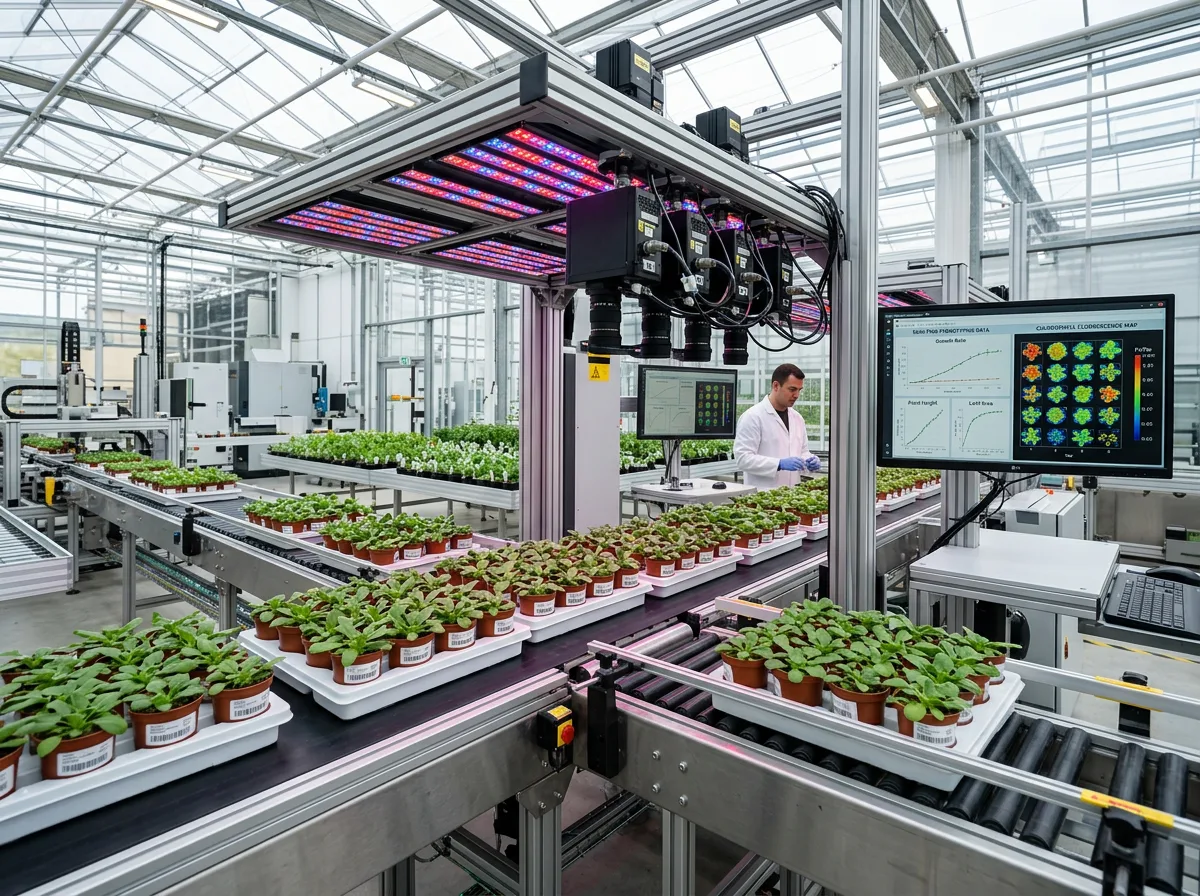
High-Throughput Phenotyping
Robotic platforms such as Phenoscope (INRAE). High-uniformity white LED coupled with multispectral imaging. No spectral interference with phenotyping sensors.
- Uniformity >95%
- Compatible with RGB/NIR imaging
- Dimming 0-100% flicker-free
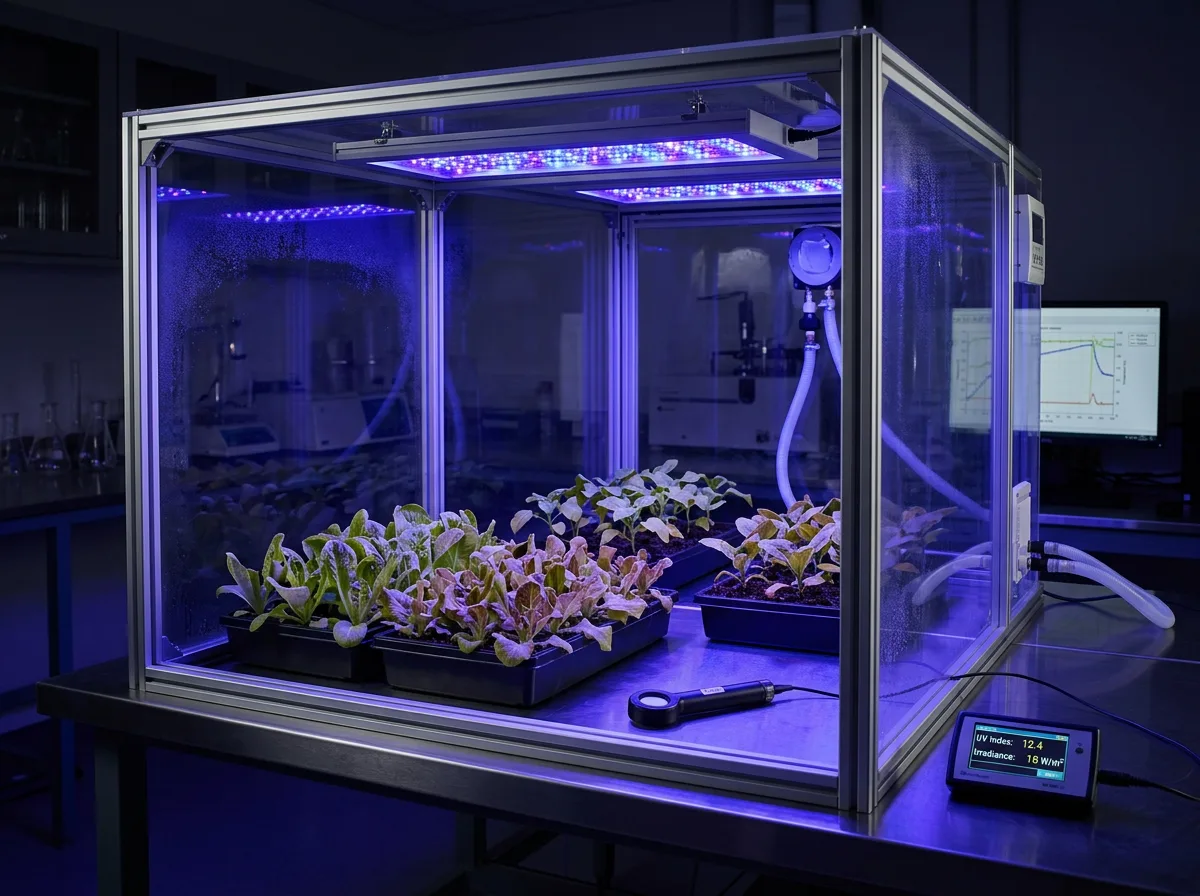
Controlled UV Stress
Dosed UV-A/UV-B exposure to stimulate secondary metabolite production: flavonoids, anthocyanins, terpenes and cannabinoids (THC/CBD). Reproducible protocols.
- UV-B 280-315 nm controlled
- Integrated dose/duration timer
- +40-200% metabolites
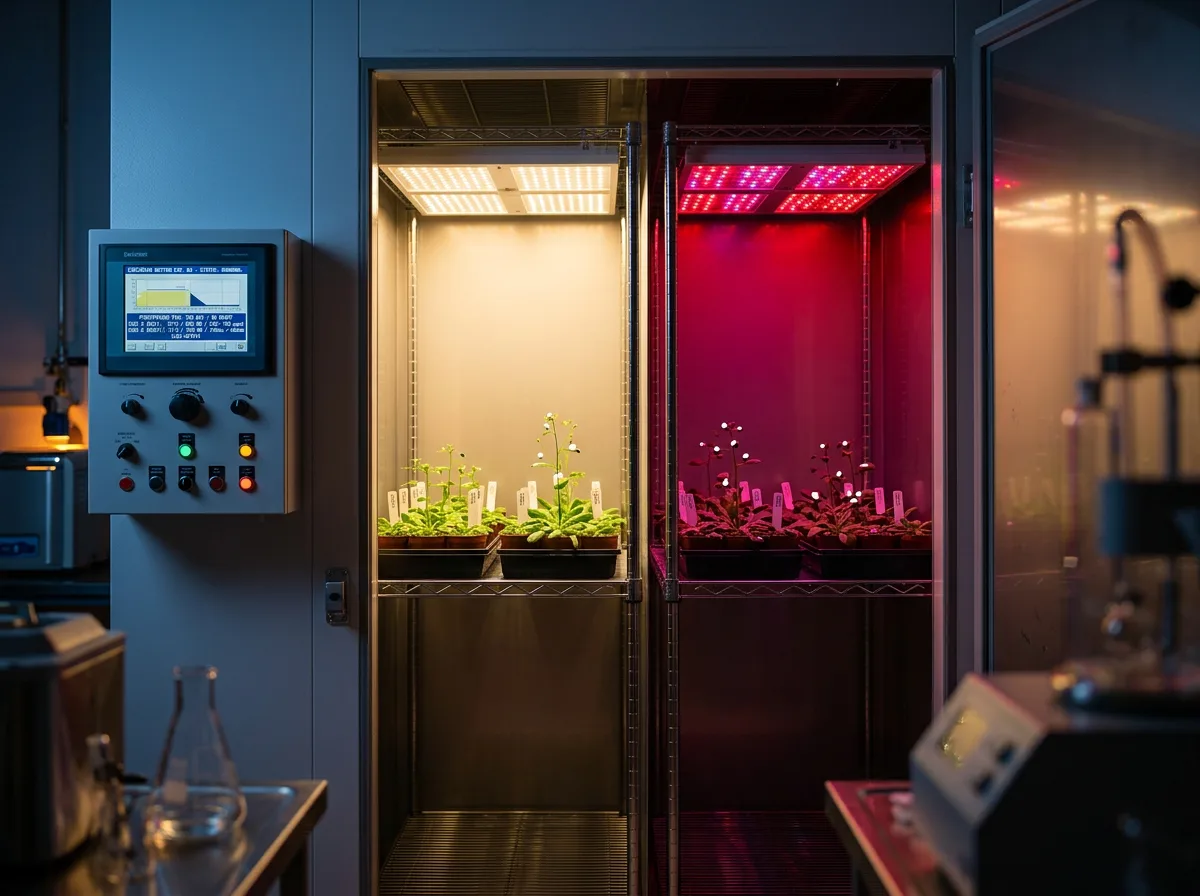
Circadian Studies
Photoperiodism, progressive dawn/dusk transitions, day-length-induced flowering mechanisms. Simulation of photoperiods from 8 h to 24 h with spectral ramps.
- Dawn/dusk spectral ramps
- Programmable photoperiod
- DLI accurate to 0.1 mol/m²/day
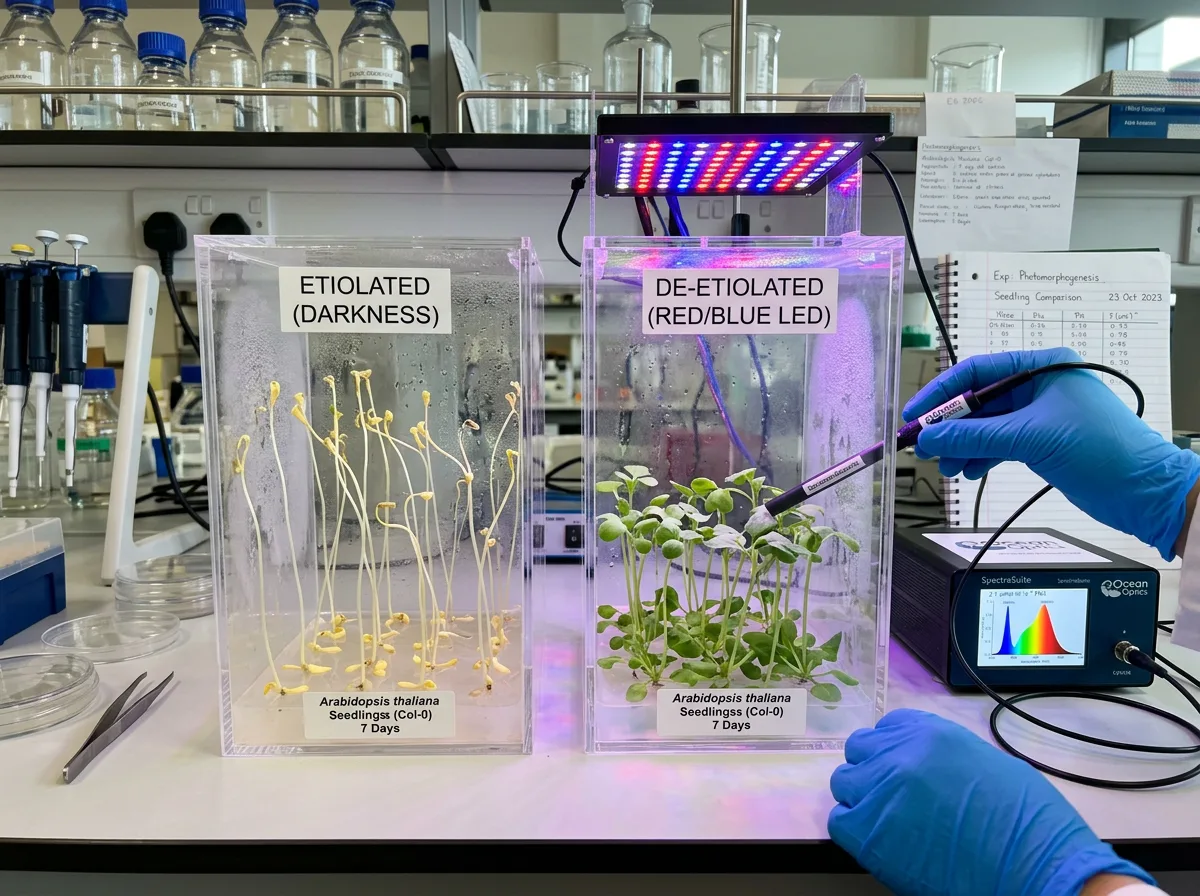
Photomorphogenesis
Canopy architecture, internode elongation control, photoblastic germination. Multi-channel spectra to decouple the effects of each spectral band.
- 6-8 independent channels
- Variable R/FR ratio 0.5-8.0
- DALI/DMX protocol
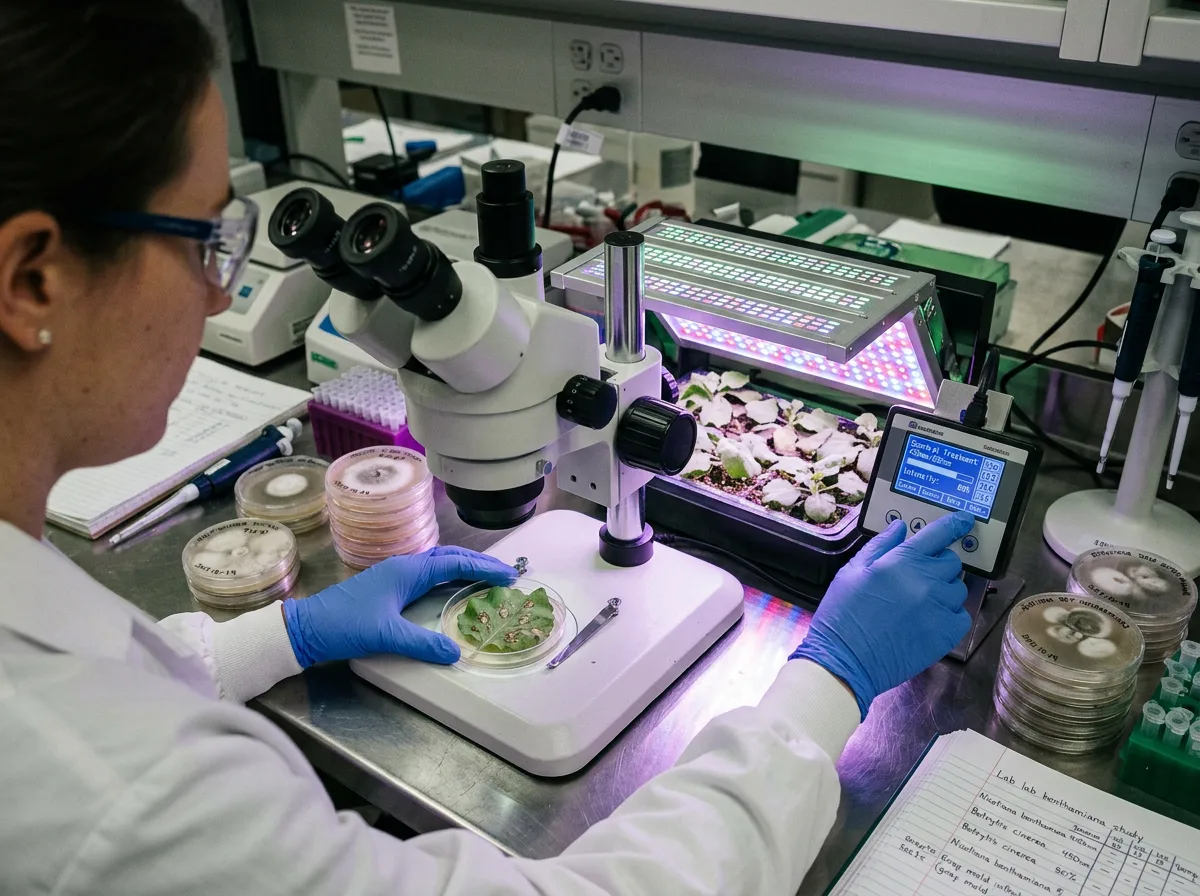
Plant-Pathogen Interactions
Impact of LED spectra on disease resistance. Spectral quality modulates plant immune defences and the development of pathogens.
- Antifungal spectra
- SAR defence activation
- PathoLED network (GEVES)
Light Spectrum Configurator
Spectrum Parameters
Measurement Protocols & Standards
Metrological rigour is at the core of our approach. Each installation is validated according to standardised protocols ensuring the reproducibility of your experiments.
Calibrated Quantum Sensors
Spatial network of quantum sensors (LI-COR LI-190R type) to map PPFD uniformity across the entire cultivation surface. Measurement grid 25 × 25 cm.
DLI — Temporal Integration
The Daily Light Integral (DLI) is calculated by integrating PPFD over the photoperiod duration. Each light recipe specifies a target DLI in mol/m²/day, from 6 (in-vitro) to 40+ (high PPFD).
DIN 5031-10 Action Curves
Each spectrum is characterised according to DIN 5031-10 photomorphogenic action curves: photosynthesis (McCree), germination, elongation, phototropism, phytochrome conversion.
Spectroradiometry & Calibration
Measurements by portable (Jeti Specbos type) and laboratory spectroradiometers. Calibration against NIST source. Individual spectral certificate for each delivered fixture.
Inter-Laboratory Reproducibility
Each fixture from the same batch exhibits a spectral deviation below 2%. Standardised measurement protocols enable result comparison across sites.
ISO & Safety Certifications
ISO 9001 manufacturing. UL-508A electrical compliance and CE marking. IP65 protection for humid environments. REACH and RoHS materials compliance.
Quality System
European Conformity
Humidity Protection
Compliant Materials
Trusted by Leading Institutions
French and European research institutes using our LED solutions for their scientific programmes.
PEPLor — Champenoux
INRAE Grand-Est Nancy
3 phytotrons of 9 m² each, equipped with LED ceilings delivering up to 1,200 µmol/m²/s. Research in forest ecophysiology and tree response to climate change.
Phenoscope — IJPB
INRAE Versailles-Grignon
High-throughput phenotyping platform for Arabidopsis. Conveyor robots, high-uniformity white LED coupled with automated imaging. Analysis of hundreds of plants per day.
PathoLED Network
GEVES — Groupe d'Étude et de contrôle des Variétés et des Semences
Multi-site research programme studying the impact of LED spectra on plant-pathogen interactions. Objective: reduce fungicide use through spectral modulation.
Scientific Publications
2023-2026
Our fixtures are cited in peer-reviewed publications on the impact of LED spectra in plant research: photomorphogenesis, secondary metabolites and abiotic stress.
The spectral precision of GrowLED PRO fixtures enabled us to publish 100% reproducible results across our three phytotrons. The negligible drift after two years of intensive use confirms the manufacturing quality.
Dr. S. L.
Researcher in Plant Biology — Public Research Institute
Scientifically Irreproachable Data
Configure your spectrum, receive a DIALux simulation report and a technical proposal tailored to your research protocol.
Scientific resources: LED and plant research
Stress lumineux et LED : simuler des conditions expérimentales en recherche végétale
Simuler le stress lumineux : UV-B, photoinhibition, fluctuations nuageuses, mesure Fv/Fm. Protocoles et équipements pour la physiologie végétale expérimentale.
Phytotrons et salles de croissance contrôlée : dimensionnement LED professionnel
Dimensionner l'éclairage LED d'un phytotron : CV < 3%, flicker PstLM < 0.1, BACnet/DALI-2, budget 30k–700k€, financements ANR/CPER/EquipEx+.
Éclairage LED pour la micropropagation végétale in vitro
LED en culture in vitro : PPFD 50–120 µmol/m²/s par stade, spectre par phase (callogenèse, organogenèse, enracinement), -70% vs tubes fluorescents.